Maths teachers gather evidence of learning constantly.
A starter question.
Mini-whiteboard responses.
An exit ticket.
A short quiz.
An end-of-topic test.
But those assessments can serve very different purposes.
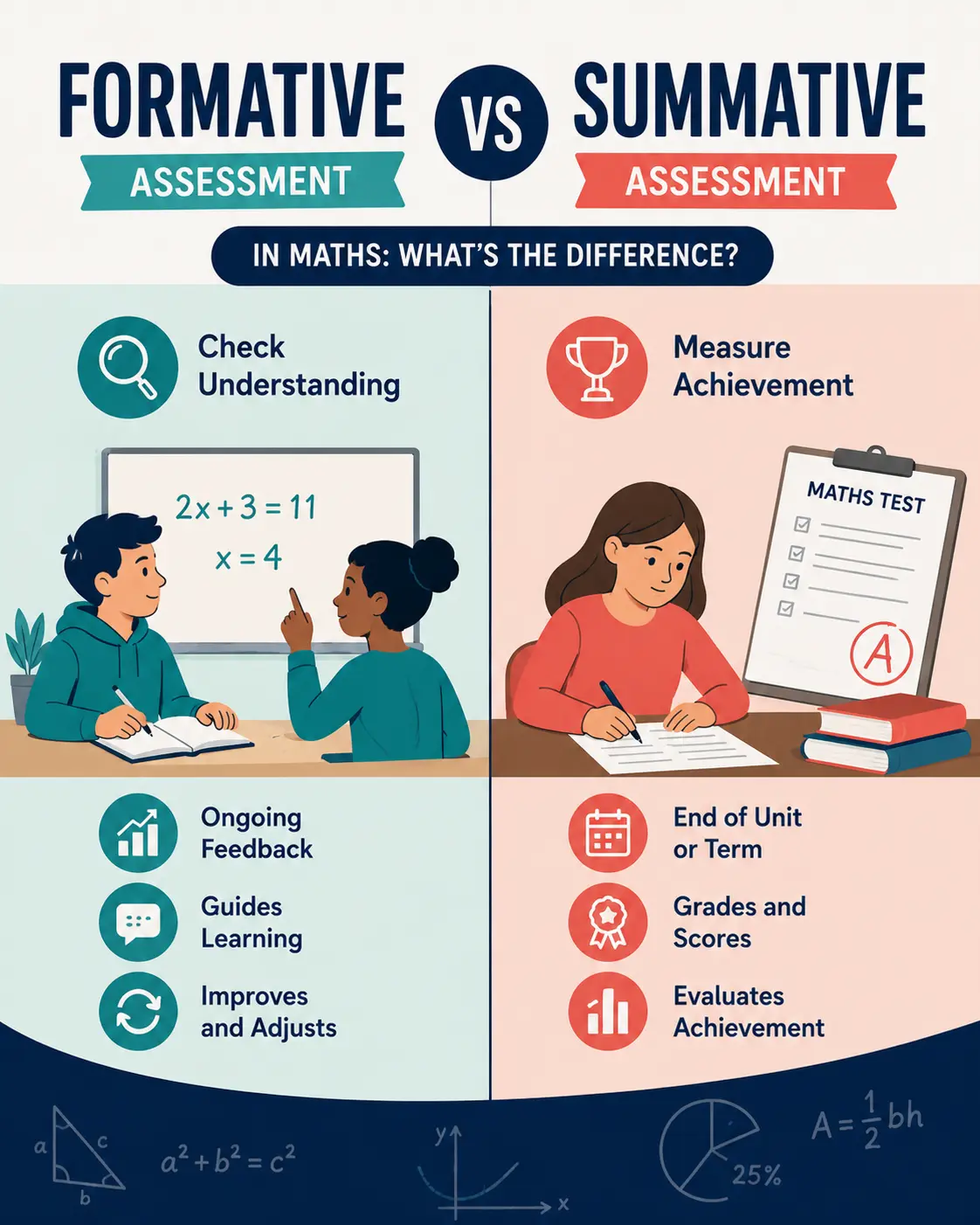
What is formative assessment?
Formative assessment takes place while learning is still developing.
The main question is:
What should we do next?
Suppose pupils complete three equations at the end of a lesson.
If a large proportion make the same mistake, the teacher can respond during the next lesson.
The assessment has directly informed teaching.
What is summative assessment?
Summative assessment is usually used after a larger period of teaching.
The question becomes:
What has the pupil learned by this point?
An end-of-topic assessment is a common example.
The same question can serve both purposes
Consider:
5x + 3 = 28
Used as an exit question, it can provide formative information.
Used in an end-of-unit test, it contributes to a more summative judgement.
The difference is therefore not simply the question.
It is how the evidence is used.
Maths benefits from both
Without formative checking, gaps may only become visible during the final assessment.
Without some form of later assessment, it can be difficult to determine what pupils have ultimately mastered.
A useful cycle is:
teach → check → adapt → practise → check again → assess.
AI can support both
For formative assessment, AI can quickly generate a few fresh questions.
For larger assessments, AI can help generate:
a structured test;
different difficulty levels;
answers;
alternative versions.
The teacher remains responsible for what is assessed and what happens as a result.