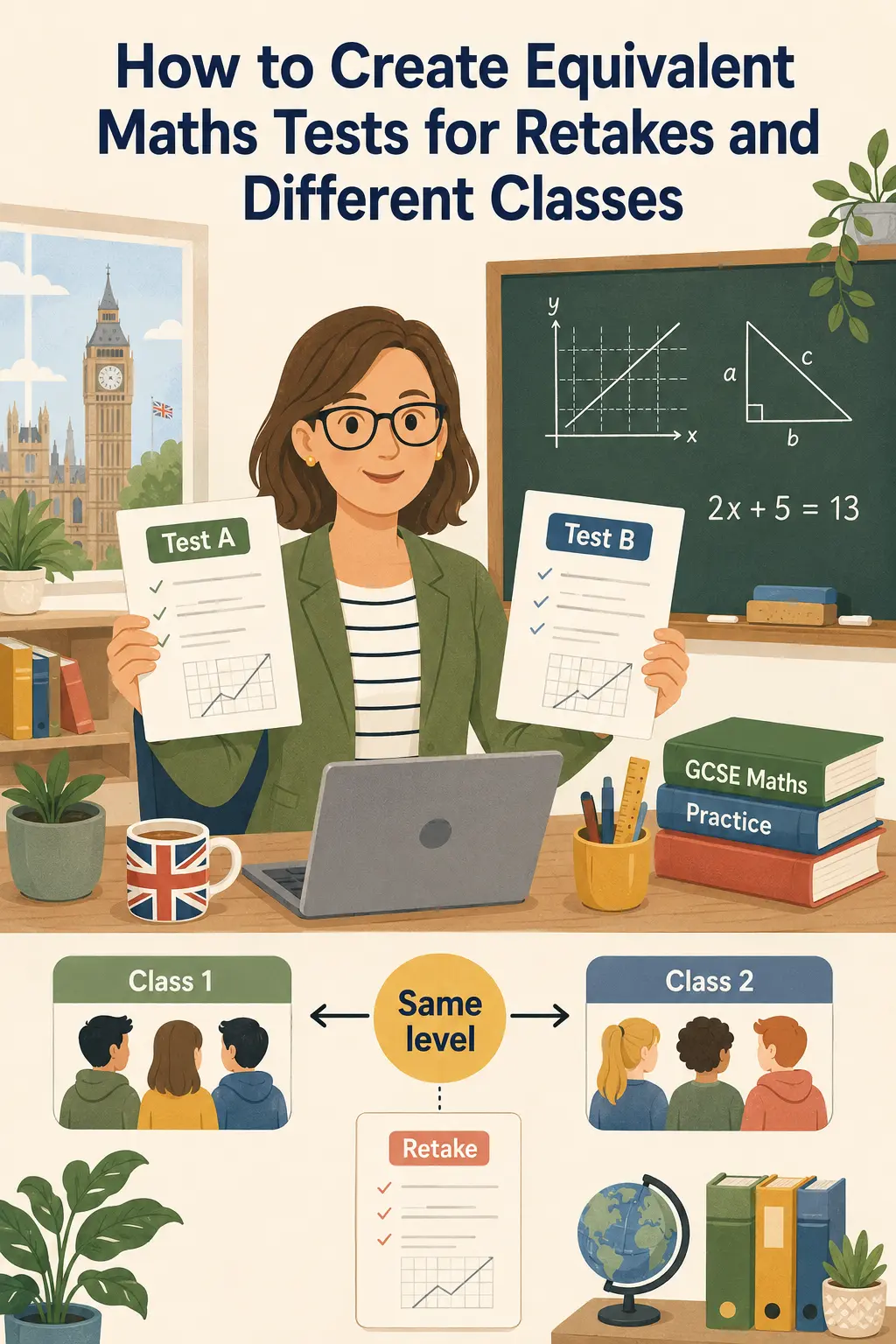
Sometimes one version of a maths test is not enough.
A teacher might need another version because:
different classes take the test at different times;
a pupil was absent;
a retake is required;
pupils are sitting close together.
Creating Version A and Version B sounds simple.
The difficult part is making them genuinely equivalent.
Different numbers do not guarantee equal difficulty
Consider:
Version A: 2x + 5 = 17
Version B: 7x − 13 = 50
Both assess equations.
But the arithmetic and number of steps may create slightly different demands.
Across an entire paper, those differences can accumulate.
Create the blueprint first
Before writing the second version, define what each question assesses.
For example:
1. fundamental skill; 2. calculation; 3. representation; 4. application; 5. interpretation; 6. multi-step problem; 7. contextual problem; 8. application; 9. reasoning; 10. challenge. Then create a parallel question for each position.
Compare complexity
Look at:
- number of steps; - numerical difficulty; - amount of reading; - diagrams; - prior knowledge required; - reasoning demand. The questions do not need to be identical.
The assessment demand should be similar.
Retakes are a particularly good use case
Using exactly the same questions can introduce a memory effect.
Using a completely different paper may accidentally change the difficulty.
An equivalent second version gives pupils:
different questions but the same learning objectives.
AI can reduce duplicate work
Creating two papers manually often means:
two sets of questions;
two answer sheets;
two sets of calculations;
two formatted documents.
AI can reduce much of that repetitive preparation.
MathQuizily can help create alternative versions while keeping the underlying assessment structure comparable.