A printable maths test should be ready to use in a real classroom.
That means much more than having questions on a page.
A useful assessment needs clear mathematical notation, enough working space, appropriate difficulty and an answer sheet that makes marking practical.
Clear mathematical notation
Fractions should be easy to read.
Indices should display correctly.
Graphs should be properly labelled.
Geometry diagrams should be large enough to interpret.
Poor mathematical formatting can turn a straightforward question into an unnecessarily confusing one.
Enough room for pupils to work
Pupils need space to show:
- calculations, - algebraic steps, - diagrams, - and reasoning.
A printable test should therefore be designed as a working document rather than simply as a compact page of text.
Balanced difficulty
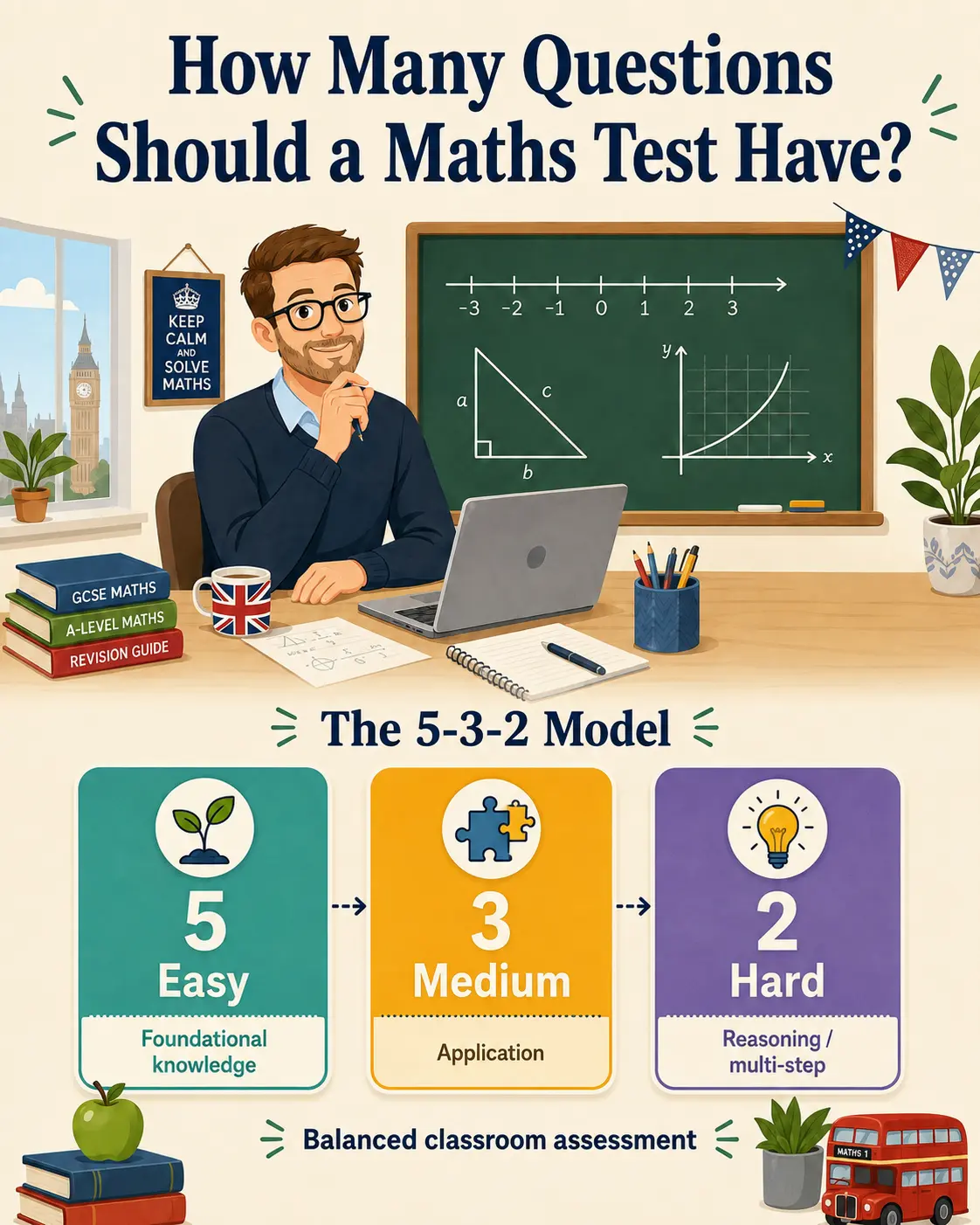
A test consisting only of straightforward exercises tells teachers very little about pupils who have progressed beyond the basics.
A useful assessment might contain:
- foundational questions; - application; - a small number of deeper reasoning problems.
Answers versus worked solutions
For simple tasks, an answer may be enough.
For more complex mathematics, worked solutions are often more useful.
They can make marking faster and make it easier to identify exactly where a pupil's reasoning went wrong.
Review topic coverage
Even a beautifully formatted PDF is not useful if half the questions do not match what was taught.
Teachers should always review:
- content, - difficulty, - language, - and mathematical accuracy.
Generate instead of searching endlessly
Teachers often spend significant time searching for a printable test that is close to what they need.
Another approach is to create the assessment around the actual topic being taught.
MathQuizily allows teachers to select the topic and level and generate a printable maths assessment with answers.
The teacher then reviews it before use.
That turns the workflow from:
search -> download -> adapt
into:
choose -> generate -> review -> print.