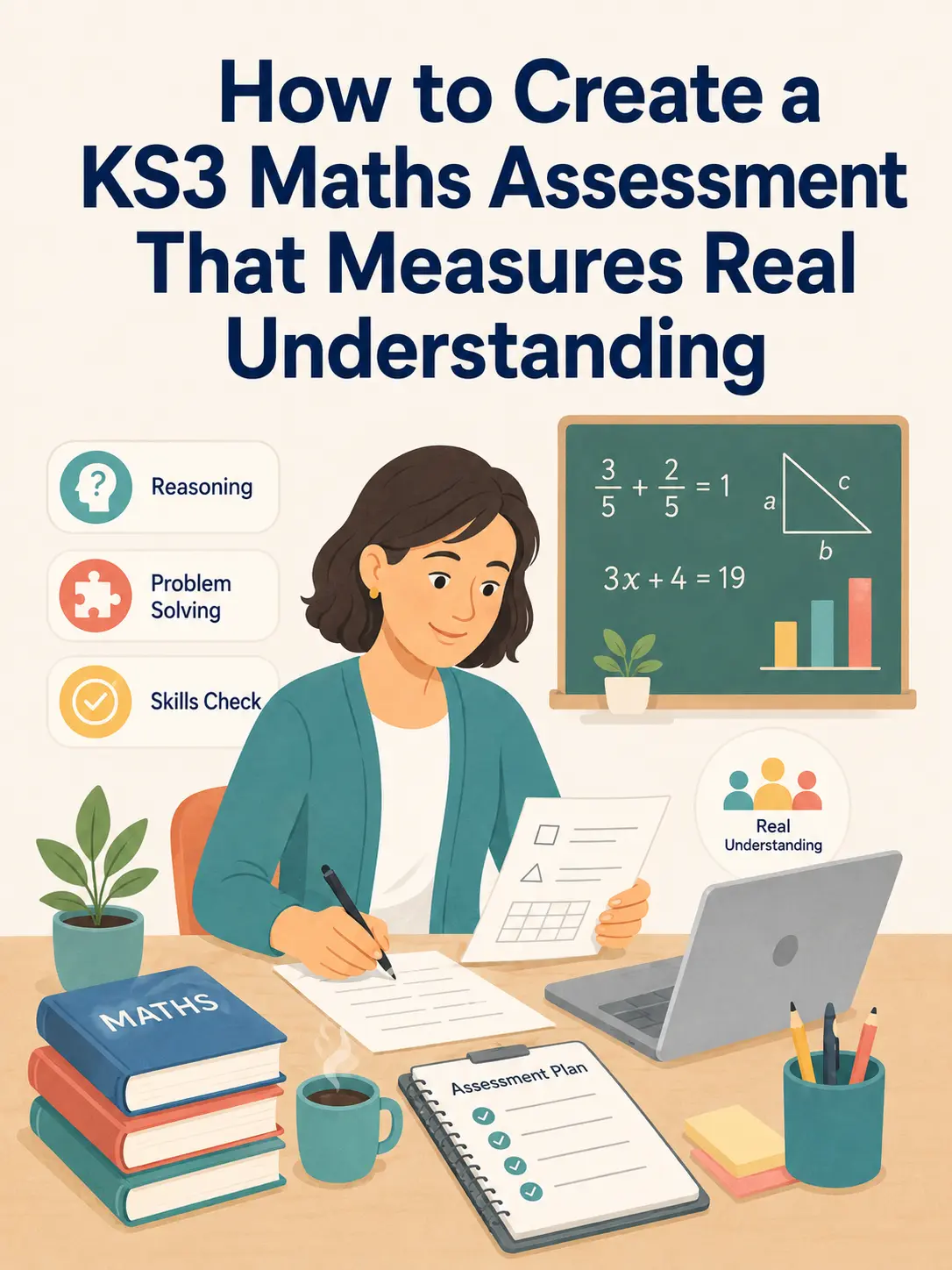
A good KS3 maths assessment should tell you more than whether pupils can reproduce a method from yesterday's lesson.
It should help reveal whether pupils understand the mathematics well enough to apply it in different situations.
Begin with the topic
A KS3 assessment might focus on:
- number; - algebra; - ratio and proportion; - geometry; - statistics; - probability.
Avoid trying to assess everything at once unless the assessment is specifically intended as a broader review.
Identify the key skills
Suppose the topic is algebra.
You might want pupils to demonstrate that they can:
- simplify expressions; - substitute values; - solve equations; - use formulae; - interpret simple algebraic relationships.
Once those objectives are clear, designing appropriate questions becomes much easier.
Avoid ten versions of the same exercise
Ten routine equations primarily measure whether pupils can repeat one procedure.
A stronger assessment might ask pupils to:
- solve an equation; - identify an error; - choose the correct expression; - construct an equation; - interpret a solution; - solve a contextual problem.
Now the assessment provides a much richer picture.
Use graduated difficulty
Start with accessible questions.
Then increase the challenge.
This gives pupils a chance to establish confidence while still providing opportunities for stronger pupils to demonstrate deeper understanding.
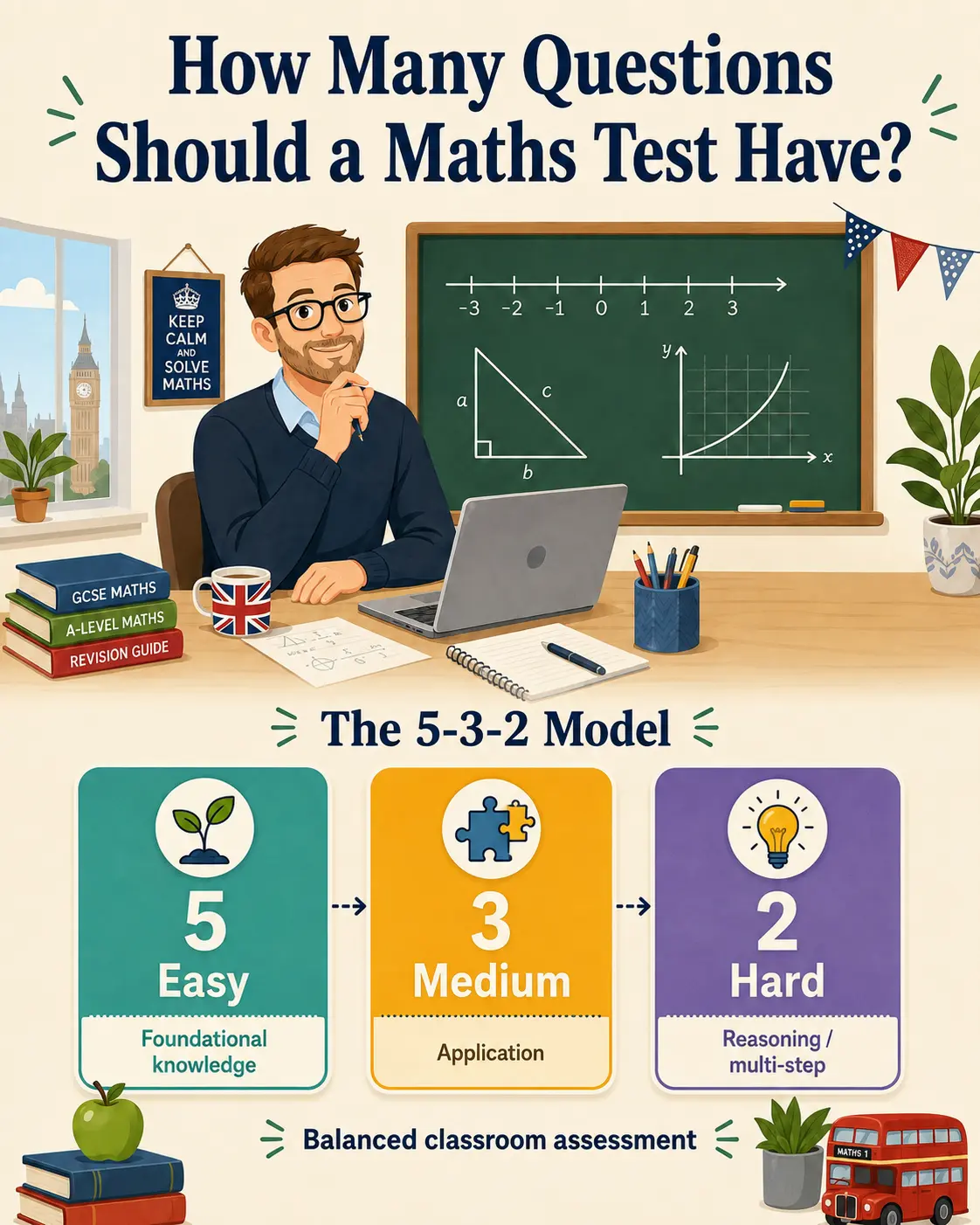
A simple ten-question structure is:
- 5 fundamental; - 3 application; - 2 challenging.
Provide space for working
Maths assessments should be designed for pupils to write on.
Allow enough space for:
- calculations; - diagrams; - working; - explanations.
Trying to squeeze too many questions onto each page can make a test unnecessarily difficult to complete.
Use the results to inform teaching
After marking, don't only record the score.
Look for questions that large numbers of pupils answered incorrectly.
If half the class makes the same mistake, that may tell you something important about the learning rather than about individual pupils.
AI can speed up the first draft
AI can help generate a structured first version of a KS3 assessment.
The teacher can then review the questions, remove unsuitable content and ensure the final assessment matches what has actually been taught.